
St. Ambrose University is giving future physical therapists a rare opportunity to specialize early in their careers – without leaving the state. As the only university in Iowa offering an accredited orthopaedic physical therapy residency, St. Ambrose provides a streamlined path for students who want to advance their skills beyond a Doctor of Physical Therapy (DPT) degree.
“It’s a huge opportunity for Ambrose students,” said Laura McEachern ‘16, DPT ‘17, program director for the orthopaedic and pediatric residency programs. “We prioritize admission into our residency programs for our St. Ambrose DPT students, so they are the first to apply for the available residency spots. This year we have five residents in the orthopaedic program.”
A direct path to specialization
Orthopaedics is one of the most in-demand areas of physical therapy, with many clinicians choosing to specialize in treating musculoskeletal conditions. At St. Ambrose, that path is built directly into the student experience.
After completing the DPT program, graduates can move immediately into the one-year orthopaedic residency, starting just weeks after graduation.
“They graduate in December and get to start residency right away in January,” McEachern said. “It’s a good fit for our students.”
That seamless transition is not typical across the country, where many residency programs begin months later or operate independently from academic programs. The residency is also intentionally designed to build on the SAU DPT curriculum.
“It’s a really nice progression from one program to the next,” McEachern said.
Built on experience, and built to last
Launched in 2006, the orthopaedic residency program recently welcomed its 21st cohort, marking two decades of continued growth and success.
“When St. Ambrose started this residency program, we were one of 15 programs across the country,” McEachern said. “The fact that we’ve been able to continue for over 20 years is a testament to the DPT program and our residency clinical partners and mentors.”
That longevity reflects both the strength of the program and its ability to evolve alongside the profession.
Learning beyond the classroom
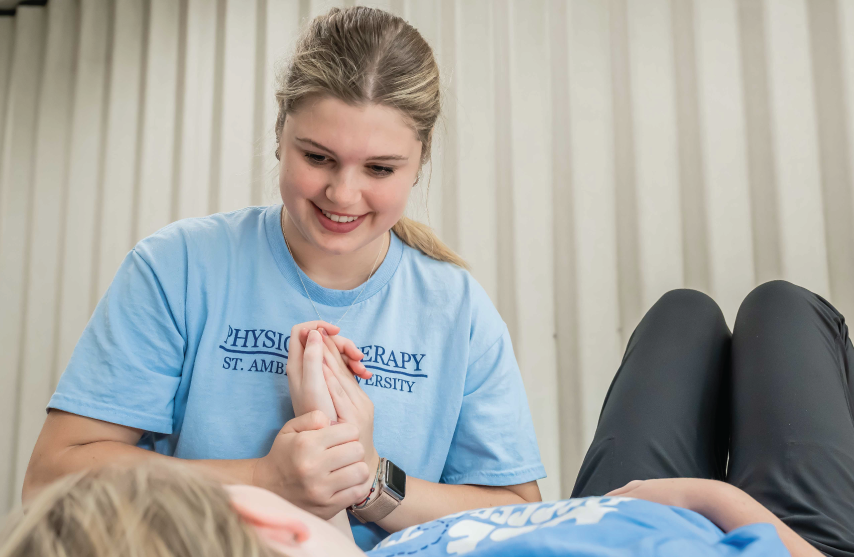
The St. Ambrose residency stands out for its emphasis on hands-on clinical experience and mentorship. Residents work full-time in outpatient orthopaedic clinics while receiving guidance from experienced clinicians. Each resident completes at least four hours of mentoring per week for the duration of the program.
“I would say the most valuable part of the residency program is the one-on-one mentoring time,” McEachern said. “You have an expert clinician that’s watching you treat patients every week, all year long.”
That level of individualized support is uncommon for new graduates entering the workforce.
“Especially as a new grad, it’s hard to find a clinic that offers substantial mentoring time, so we really prioritize that during the residency,” she said.
In addition to clinical work, residents complete advanced coursework in manual therapy, pain science, and radiology. They also participate in weekly discussions and discuss research.
A competitive edge in the field
The program is designed to prepare graduates not just for practice, but for leadership in the field. Residents are required to sit for the Orthopaedic Clinical Specialist (OCS) exam, a credential that sets them apart professionally.
At St. Ambrose, residents are prepared to take the exam immediately after completing the program with a pass rate of over 95%.
Beyond certification, the experience signals something more to employers.
“If they know they’ve done a residency, employers know the therapist has been challenged to develop strong clinical reasoning skills and a consistent thought process,” McEachern said. “It really shows that they’ve invested in themselves to improve their clinical practice to lead to better patient outcomes.”
Why St. Ambrose
While the DPT program prepares students to treat a wide range of conditions, the residency allows them to go further faster.
“You come out of the DPT program at entry level to be able to treat anything,” McEachern said. “If you want to specialize, St. Ambrose offers the opportunity to complete our orthopaedic or pediatric residency to really dive deeper into the area that you’re most passionate about. It was really exciting to celebrate 20 years of the orthopaedic residency program, but now we also have a pediatric residency program which is starting its third year.
Combined with experienced faculty, long-standing clinical partnerships, and a unique position in the state, the orthopaedic residency continues to distinguish St. Ambrose as a leader in physical therapy education.
Ready to start your journey in physical therapy and explore where it can take you? Learn more about St. Ambrose University’s Doctor of Physical Therapy.